The Pilot Worked. So Why Is It Still a Pilot?

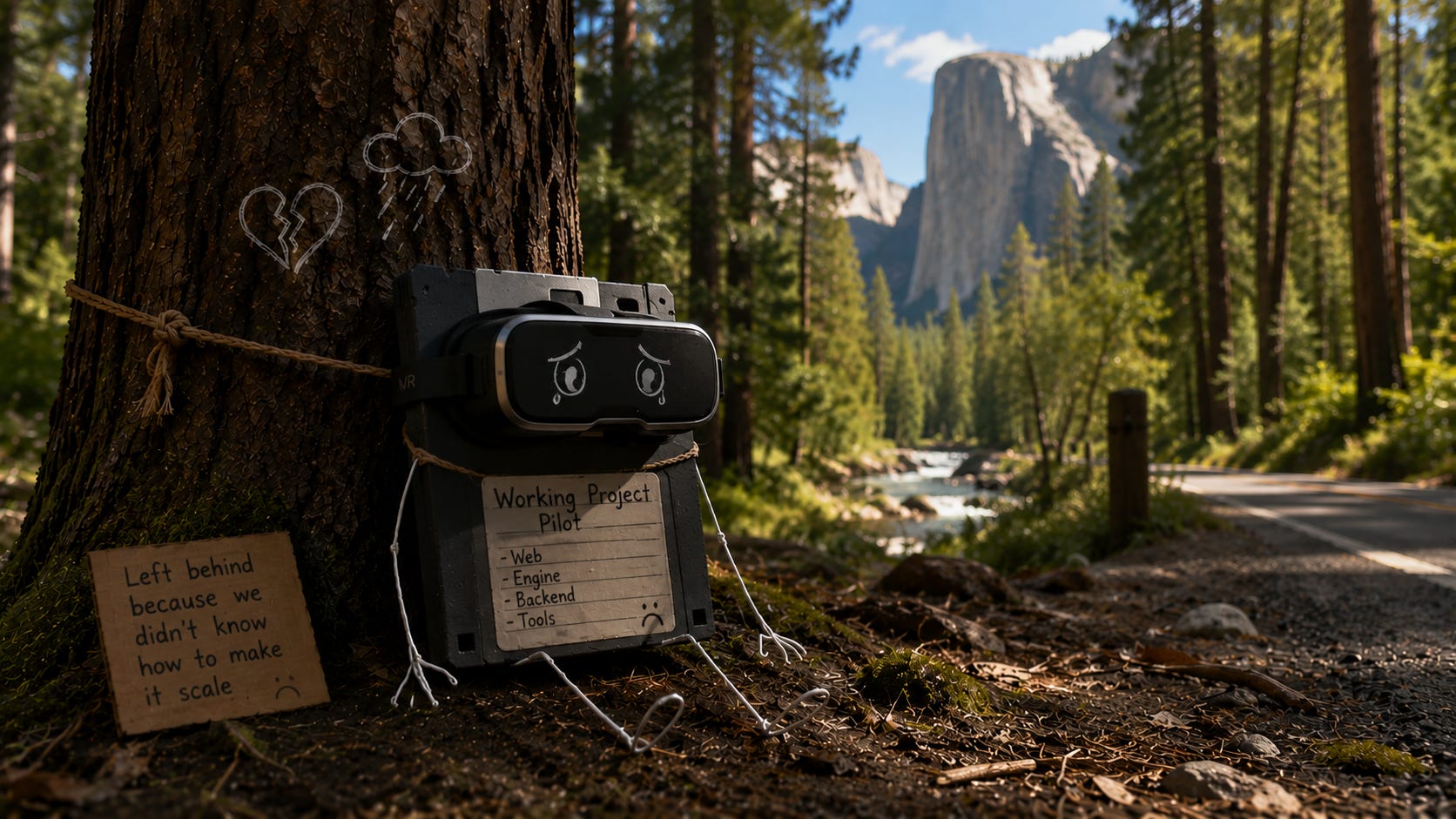
A marketing leader I spoke with recently described a familiar scene. Her team built a VR demo for a flagship product, brought it to a trade show, and watched a line form at the booth. People waited to try it. Sales had real conversations. The post-show debrief called it a success.
Eight months later, that demo is a file on a hard drive. Nobody uses it. The next trade show is being planned as if it never happened.
She wasn’t telling me a story about failure. That’s the part worth sitting with. By every measure her team set, the pilot worked. And it still went nowhere.
This is pilot purgatory, and right now it is the quietest budget killer in marketing.
Why good pilots die anyway
You’ve probably heard the term applied to AI. Teams run endless experiments, generate a few promising results, and never reach operational deployment. The tools pile up. A third of the average marketing stack sits underused. Leaders stay busy proving that things are possible without ever making them permanent.
Immersive work has its own version of this, and it’s more dangerous because the pilots usually succeed. A successful pilot is easy to celebrate and easy to shelve. It did its job at the show, it impressed the room, and then the logic stops. There’s no obvious next step, so there isn’t one.
The reason isn’t the technology. It almost never is. The reason is that the pilot was built as an experiment, and experiments are designed to end.
Think about what that means in practice. An experiment has a start date and a finish line. It answers one question, in one context, for one moment. When the moment passes, the thing has done everything it was ever built to do. So it stops. Not because it underperformed, but because it was never built to continue.
That’s the trap. You can run a flawless pilot and still be in purgatory, because success at the experiment level tells you nothing about whether the work can scale. Those are two different questions, and most pilots only answer the first one.
Some of you won’t want to admit this out loud. The moment you move from experiment to deployment, IT almost always has to get involved. Security, integration, data, who hosts what. And that’s where marketing and sales feel the most friction. The pilot was yours. The deployment suddenly belongs to a department that wasn’t in the room when you built it. A lot of good work stalls right here, not on the idea, but on the handoff nobody planned for.
The difference between an experiment and a first layer
Here’s the shift that gets a pilot out of purgatory. Stop building experiments. Start building first layers.
A first layer looks almost identical to a pilot on day one. Same budget range, same single use case, same trade show booth. The difference is in what it’s made of and what it’s connected to. A first layer is built so the next thing can reuse it.
The 3D model behind that trade show demo shouldn’t live and die at the booth. It’s the same asset that can power a sales configurator, a remote demo for prospects who can’t visit, a training module for new dealers, a section of the website where buyers explore on their own time. Build it once as a standalone trick and you’ve spent six figures on a single weekend. Build it once as infrastructure and every later use case starts from something you already own.
This is the entire idea behind working in layers. You start small and prove value in one place, which keeps the risk low and the budget defensible. But you start in a way that compounds, so the second project is cheaper and faster than the first, and the third is cheaper than the second.
A pilot that compounds isn’t a pilot anymore. It’s the beginning of an asset base.
What it looks like when a pilot graduates
Let me make this concrete, because it’s easy to nod along and still build the next dead end.
We know the failure mode well, because we’ve been called in to look at plenty of pilots that were supposed to grow and didn’t. The pattern is almost always the same. No clear goal beyond “let’s try immersive.” No plan for what happens after the show. No KPI anyone agreed on up front, so no way to prove it earned a second round. The experience was fine. Everything around it was missing.
We worked with Toyota Material Handling Europe on a virtual showroom. Forklifts, reach trucks, automated systems. Products that are expensive to ship to a trade show, hard to demonstrate at scale, and difficult to explain through a brochure. The kind of thing that would normally become a one-off VR demo, impress a few people at a single event, and then sit on a drive.
It didn’t become that, because it wasn’t built as that. It was built as one 3D environment and one asset library, made so the same content could move into dealer training, sales proposals, trade show demos, campaigns, and AR visualizations placed on a customer’s actual warehouse floor.
Look at what that does to the math. The normal version is six separate projects, six budgets, six timelines, each one starting from zero. The layered version is one asset doing the work of six. ROI stops being a number you calculate per campaign and recalculate every time. It compounds across the whole life of the asset.
That’s the difference between a pilot and a first layer, sitting in the same product, the same industry, the same trade show floor you already know. One ends at the booth. The other keeps paying out long after the show is over.
The starting point looked nearly identical to the demo that dies. Same budget conversation, same single use case to begin with. What changed was the intent behind it. It was built to graduate.
The question your CFO is actually asking
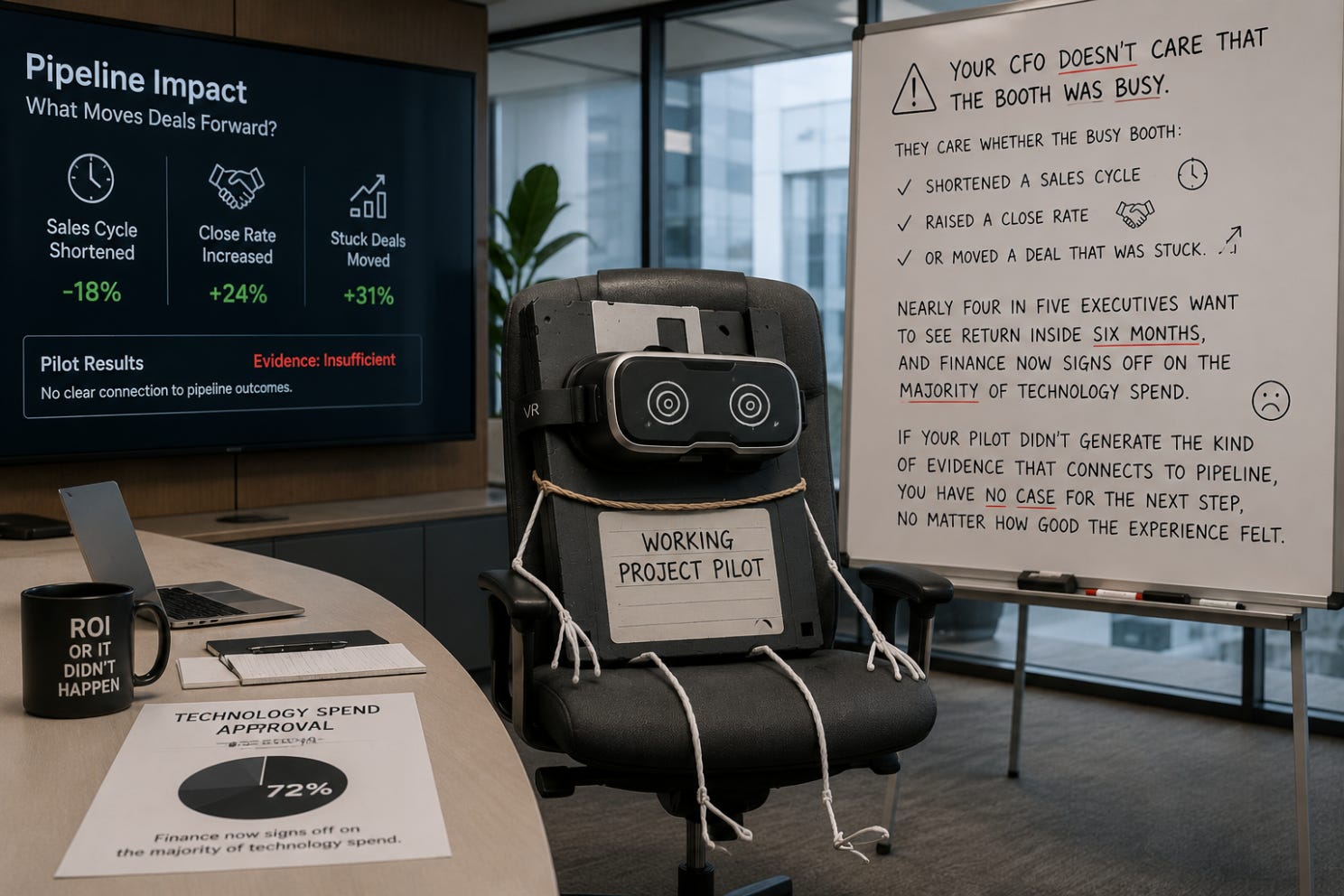
No floppies were hurt or kidnapped.
There’s a measurement problem hiding underneath all of this, and it’s the one that decides whether you ever get to scale.
Most pilots are scoped to look good in the room. Footfall, dwell time, a few enthusiastic quotes. That’s enough to call a pilot a success. It is nowhere near enough to justify a second investment to the person who controls the budget.
Your CFO doesn’t care that the booth was busy. They care whether the busy booth shortened a sales cycle, raised a close rate, or moved a deal that was stuck. Nearly four in five executives want to see return inside six months, and finance now signs off on the majority of technology spend. If your pilot didn’t generate the kind of evidence that connects to pipeline, you have no case for the next step, no matter how good the experience felt.
So the pilot sits. Not because it was bad, but because it can’t prove it was good in the only language that unlocks more budget.
A first layer is built with that conversation in mind from the start. You decide before you build what you’re going to measure and how it ties to revenue. Then the pilot doesn’t just perform. It produces the argument for its own future.
This is the part most immersive content skips, because it’s less fun than the headset. But it’s the whole game. The experience has to work for the visitor and for the CFO, in two completely different languages, at the same time.
Before your next pilot, ask one thing
The next time someone on your team proposes an immersive pilot, ask a single question before you approve it. If this works, what’s the second thing it becomes?
If the answer is clear, you’re building a first layer. The trade show demo becomes the sales tool becomes the training asset, each one cheaper than the last, each one feeding the next.
If there’s no answer, you’re not building a pilot. You’re building a dead end with good production values. It will probably work. People will probably line up. And eight months from now it will be a file on a hard drive, while you start the conversation over from zero.
The technology was never the thing holding you back. The approach was. Pilot purgatory isn’t where projects go because they failed. It’s where they go because nobody built them to graduate.
Take an honest look at the immersive work your organization has run in the last two years. Count how many pieces are still in use, and how many became files nobody opens. If that ratio bothers you, the fix isn’t a better pilot. It’s a different way of starting.
There’s a second trap waiting on the other side of this one, though. Because once you start building first layers instead of experiments, you run into a harder problem. Who owns the asset? Not the file. The strategy. In most organizations the answer is nobody, and that’s where even well-built layers quietly fall apart. More on that next time.
How can I help
We can start with a coffee. In a coffee shop, ironically, that will still make you kidnap your phone one more time to find the way.